

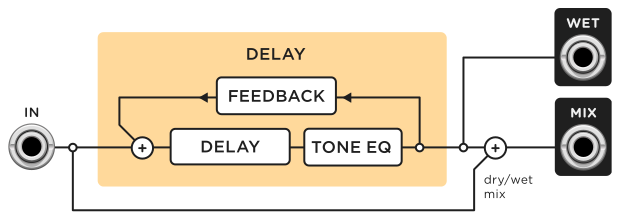
A delay effect records an audio signal and plays it back after some amount of time. Early delay hardware used analog tape loops to write and record with different magnetic heads, while most modern delay effects record digital signals using a memory buffer. In either case, repeated “taps” of delay can be added using a feedback loop with optional EQ.
The delay TIME of VCV Delay can be adjusted from 1 ms to 10 seconds. When the TIME CV attenuator is set to 100%, the CV input controls the time using the 1V/octave standard, meaning that each additional volt of CV decreases the time by half (i.e. increases the frequency by 2).
The WET output plays the wet (delayed) signal. The MIX knob adjusts the balance between the dry (input) and wet (delayed) signal in the MIX output.
The TONE knob controls a DJ-style filter, low-pass filtering the wet signal when turned to the left and high-pass filtering when turned to the right.
The FDBK knob adjusts the level of feedback of the post-filtered wet output into the delay processor.
The delay time can be synchronized to a clock when it is patched to CLK. When patched, the TIME value multiplies or divides the clock frequency.