Compares two voltages
2.6.4
Author: VCV
License: GPL-3.0-or-later
Last updated:
Created:
Plugin: VCV Free
This CV processor performs various comparisons between two CV signals A and B
The B OFFSET knob adds a fixed offset to the B voltage, or sets the voltage directly if B is unpatched.
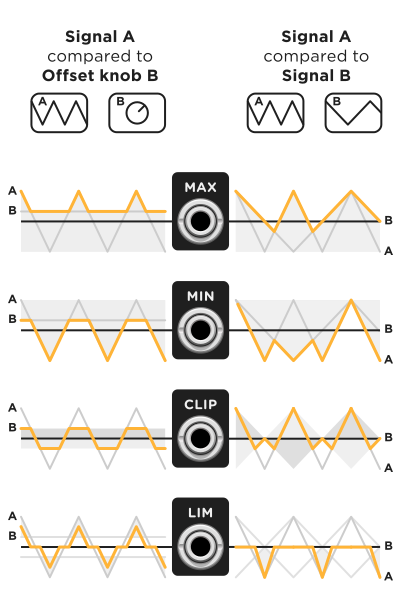
MAX is the largest value of A and B. For example, if A is 3V and B is 6V, MAX is 6V.
MIN is the smallest value of A and B. For example, if A is 3V and B is 6V, MIN is 3V.
The CLIP CV output processes signal A by clipping it to the range -B to B. For example, if B is 5V, all values of A below -5V are limited to -5V, and all values above 5V are limited to 5V. Values of A between -5V and 5V are unchanged.
The LIM CV output outputs the portion of the A signal that is beyond the range -B to B. For example, if A is 8V and B is 5V, A is beyond 5V by 3V, so LIM is 3V. Values of A between -5V and 5V result in LIM of 0V, since A is not beyond this range.
Note: CLIP + LIM is always equal to A, so you can think of these two outputs as breaking the A signal into two parts.
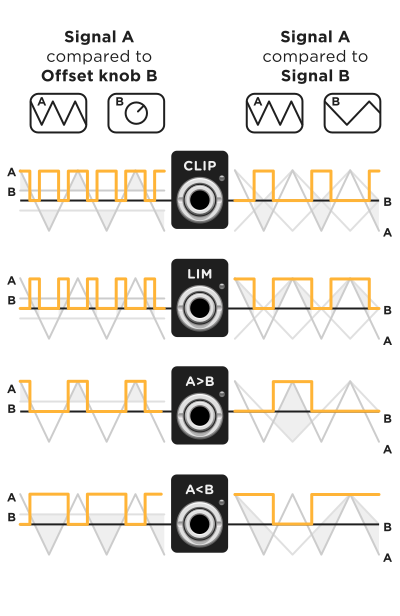
The CLIP gate output (below the CLIP CV output) is HIGH when A is outside the range -B to B.
The LIM gate output (below the LIM CV output) is HIGH when A is inside the range -B to B.
A>B is a gate that is HIGH when the A voltage is greater than the B voltage.
A<B is a gate that is HIGH when the A voltage is less than the B voltage.