

Multicolored noise generator
2.6.4
Author: VCV
License: GPL-3.0-or-later
Last updated:
Created:
Plugin: VCV Free
VCV Noise generates 7 colors of noise, each with a different characteristic and frequency response.
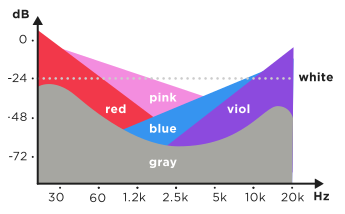
White noise (WHT output) has equal intensities at all frequencies. Each voltage is sampled from a normal distribution.
Pink noise (PINK output) has more bass than white noise, and its intensity decreases by -3 dB/octave.
Red noise (RED output) has more bass than pink noise, and its intensity decreases by -6 dB/octave.
Violet noise (VIOL output) has more treble than blue noise, and its intensity increases by +6 dB/octave.
Blue noise (BLUE output) has more treble than white noise, and its intensity increases by +3 dB/octave.
Gray noise (GRAY output) is calibrated to a psychoacoustic equal loudness curve. The human ear does not hear all frequencies with equal intensity (e.g. white noise sounds louder around 1000 Hz than 100 Hz, although its actual power density is the same), so a filter with an equal loudness frequency response is needed to produce noise that sounds uniform across the audible frequency range. In particular, the gray noise generated by VCV Noise is inverse A-weighted.
Black noise (BLK output) has no single standard definition, so VCV Noise defines it as “uniform noise”, i.e. voltages sampled from a uniform distribution. Uniform noise has nearly the same frequency response as white noise, except that it contains aliasing. This effect is similar to early digital noise generators or poorly-designed software noise algorithms. However, uniform noise is useful for sample-and-hold sources, CV, and other non-audio purposes.