Voltage-controlled amplifier
Voltage-controlled amplifier Polyphonic
2.6.4
Author: VCV
License: GPL-3.0-or-later
Last updated:
Created:
Plugin: VCV Free
A voltage controlled amplifier applies gain/attenuation to an audio or CV signal according to another CV signal. For example, you can control the volume level of a synth voice with an envelope generator or sequencer.
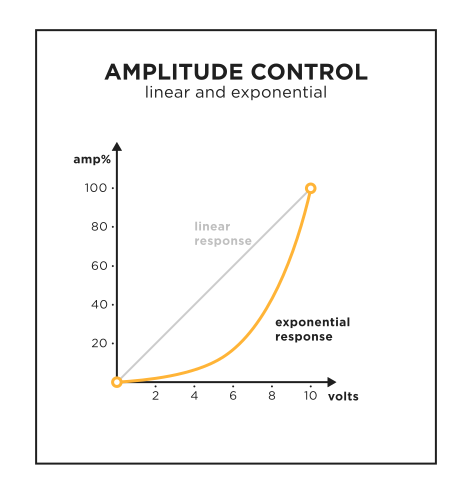
With VCV VCA, a signal passing through IN to OUT is attenuated based on the CV input signal from 0% at 0V, to 100% at 10V. CV input is clamped, meaning that negative CV or CV beyond 10V results in 0% and 100% attenuation, respectively.
The amount of gain is displayed by the vertical yellow bar in the display. You can apply manual level attenuation by clicking and dragging the display up or down.
Settings
By default, VCV VCA applies mathematically-ideal linear amplification, so the output signal follows the equation OUT = IN × (CV / 10V).
For example, a CV signal of 5V attenuates the input signal by 50%.
However, many hardware modular VCA’s apply exponential amplification, so you can enable this behavior by right-clicking the panel and enabling “Exponential response”. In this mode, the upper range of CV applies more accelerated level changes than the lower range, giving envelopes a more aggressive response.