

Voltage-controlled filter
2.6.4
Author: VCV
License: GPL-3.0-or-later
Last updated:
Created:
Plugin: VCV Free
A voltage controlled filter removes a range of frequencies from an audio signal, with its cutoff frequency controlled by an external voltage. Filters are used in many types of synthesizer patches to control the intensity or harmonic richness of audio signals.
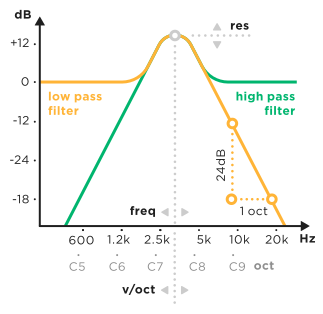
VCV VCF models an analog 4-pole transistor ladder, a popular type of filter circuit designed in the 1960s. Audio from the IN input is processed through a low-pass filter (LPF) and high-pass filter (HPF).
The CUTOFF knob sets the characteristic frequency of the filter, the point where it begins to attenuate frequencies. If the cutoff attenuverter is set to 100%, the cutoff modulation input controls the frequency with the 1V/octave standard.
The RES knob controls the filter resonance, which emphasizes the signal near the cutoff frequency. At high resonance values, VCV VCF self-oscillates, creating feedback from its own internal noise near the cutoff frequency.
The DRIVE knob adds gain to the input signal which is saturated by the filter circuit model. This creates a dirtier, grungier filter sound.