Generates an envelope with Attack/Decay/Sustain/Release
2.6.4
Author: VCV
License: GPL-3.0-or-later
Last updated:
Created:
Plugin: VCV Free
An envelope generator (EG) converts a gate, having only an on and off state, into a control voltage (CV) signal with a musically useful shape. They are often used to control VCAs, VCF cutoff frequencies, or any modulation inputs.
The ADSR envelope generator was developed in the 1960s as an attempt to emulate the behavior of physical instruments such as the piano. It has four parameters:
- Attack (ATT): Rising time while gate is HIGH.
- Decay (DEC): Falling time while gate is HIGH.
- Sustain (SUS): Target CV level while decaying.
- Release (REL): Falling time when gate is LOW.
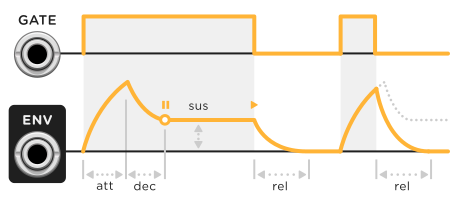
VCV ADSR EG is activated by a GATE signal or by clicking and holding the PUSH button. An envelope CV signal is generated at the ENV output, ranging from 0V to 10V.
The current stage is shown by the 4 slider lights. Although ADSR envelope generators only have 3 actual stages (attack, decay, and release), VCV ADSR EG illuminates the sustain light when the envelope has reached the sustain target level during the decay stage.
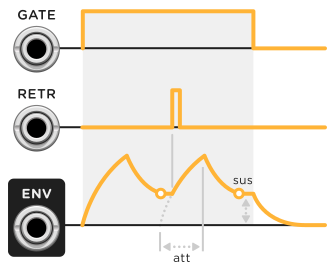
An optional RETR (re-trigger) signal can be used to reset the envelope back to the attack stage. This is useful if you want to play legato notes with VCV MIDI to CV while resetting the envelope when each new key is pressed. If you play multiple legato notes, the gate signal remains HIGH between them, so a RETR trigger is needed to notify VCV ADSR EG that a new note is being played.