

Low-frequency oscillator
Low-frequency oscillator Polyphonic
2.6.4
Author: VCV
License: GPL-3.0-or-later
Last updated:
Created:
Plugin: VCV Free
A low frequency oscillator is a voltage-controlled oscillator that is designed to oscillate at lower frequencies than audio rates. VCV LFO is nearly identical to VCV VCO, with a few differences.
The range of the FREQ knob is much lower than VCO, ranging from one oscillation roughly every 4 minutes to about 1000 Hz.
The OFST (offset) switch toggles between unipolar (0V to 10V) and bipolar (-5V to 5V) output. In both of these modes, the peak-to-peak voltage difference is always 10V.
The INV switch inverts (flips) the output signal. In unipolar mode, this inverted signal still oscillates between 0V and 10V.
The CLK input synchronizes the frequency (but not the phase) of LFO to a clock trigger. When a clock is patched, the FREQ knob multiplies the frequency, with a 1x factor at its default (12 o’clock) position.
The RESET trigger input behaves similarly to the SYNC input of VCO.
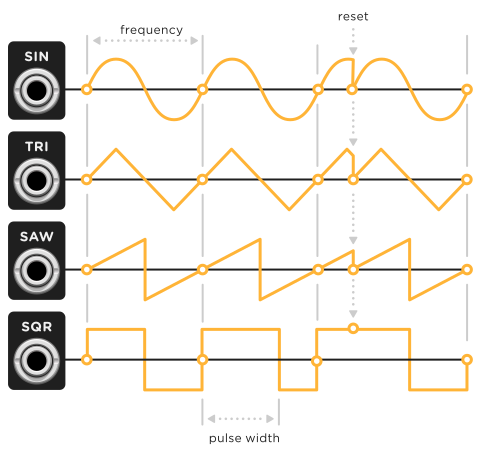
The output signals generated by LFO are similar to VCO but without anti-aliasing, so there is no Gibbs effect. This makes LFO more suitable for generating CV for modulation, while VCO is more suitable for generating audible waveforms.