

Voltage-controlled oscillator
2.6.4
Author: VCV
License: GPL-3.0-or-later
Last updated:
Created:
Plugin: VCV Free
A voltage-controlled oscillator generates raw tones at a particular frequency (pitch) and is the source sound generator of many types of synthesizer voices.
VCV VCO generates four shapes of waveforms: SIN (sine), TRI (triangle), SAW (sawtooth), and SQR (square). Each waveform contains different harmonics and therefore has a unique sound.
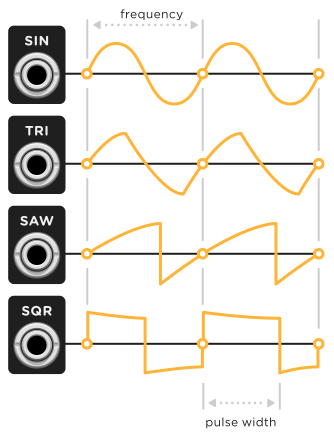
The width of the square waveform’s high portion is its pulse width, and it can be controlled by the PULSE WIDTH knob and modulated by the PWM (pulse width modulation) CV input and attenuverter. By default, the pulse width is 50% of the total waveform. Higher and lower pulse widths give reduced harmonics for a thinner sound.
The FREQ knob controls the pitch of the oscillator, with a range of 9 octaves. At its default value (12-o’clock position), the note C₄ (middle C) is generated.
To control the pitch with another module, patch a CV signal into the V/OCT input or the FM input. The V/OCT input multiplies the frequency value using the 1V/octave standard, meaning that each volt of CV increases the pitch by 1 octave, doubling the frequency. Since there are 12 semitones in an octave, each 1/12 V increment increases the pitch by 1 semitone.
The FM input applies an additional pitch adjustment with an included attenuverter knob. With the FM attenuverter at 100%, the FM input functions similarly to the V/OCT input. At lower knob positions, a smaller adjustment is applied to the pitch, for subtle vibrato, for example.
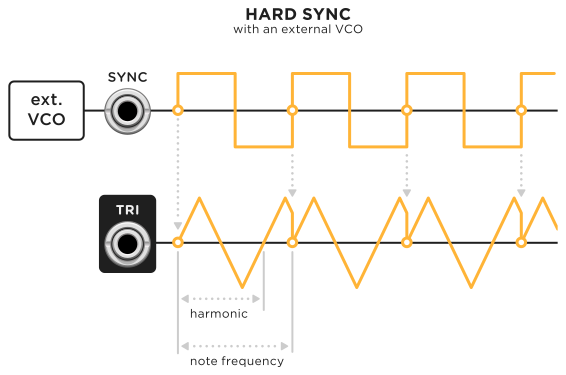
The SYNC input resets the phase of each waveform when the sync signals passes upward through 0V. This behavior is more precisely called hard sync. If an audio-rate sync signal is used, the result is a waveform having characteristics of both the internal and sync frequencies.
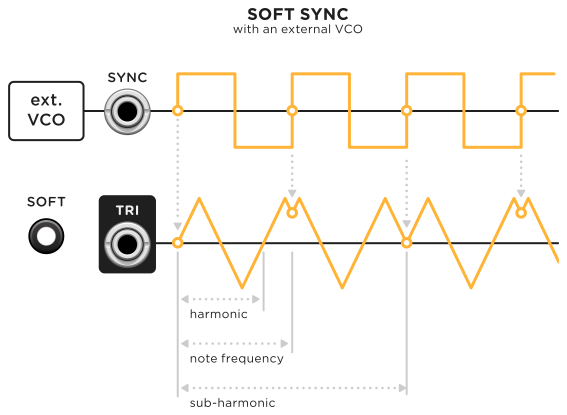
Press the SOFT button to change the sync mode to soft sync. In this mode, instead of immediately resetting the phase of the waveform, the waveform direction is reversed each time a sync trigger is received. This produces a less harsh sound with lesser harmonics than a hard-synced waveform.
Press the LFM button to enable linear frequency modulation mode. In this mode, the oscillator’s frequency is adjusted proportionally to the FM voltage rather than exponentially. If modulated with a symmetric audio-rate signal, the oscillator holds its tuning, and the sound is similar to famous hardware examples such as the DX7.
Notes
If you view VCV VCO’s saw and square outputs on an oscilloscope like VCV Scope, you might notice a “ripple” or “wiggle” around the waveform’s jump discontinuities. This effect is called the Gibbs phenomenon and is the result of using an anti-aliasing algorithm to generate only frequencies below the Nyquist frequency (half the sample rate). Without anti-aliasing, digital oscillators can include harmonics that are not integer factors of the fundamental waveform. This creates a harsh, and some might say “cheap” or “cold”, sound.