

Random CV generator
Random Sample and hold Polyphonic
2.6.4
Author: VCV
License: GPL-3.0-or-later
Last updated:
Created:
Plugin: VCV Free
VCV Random is a random CV generator with 4 types of randomness and a triggerable sample-and-hold function.
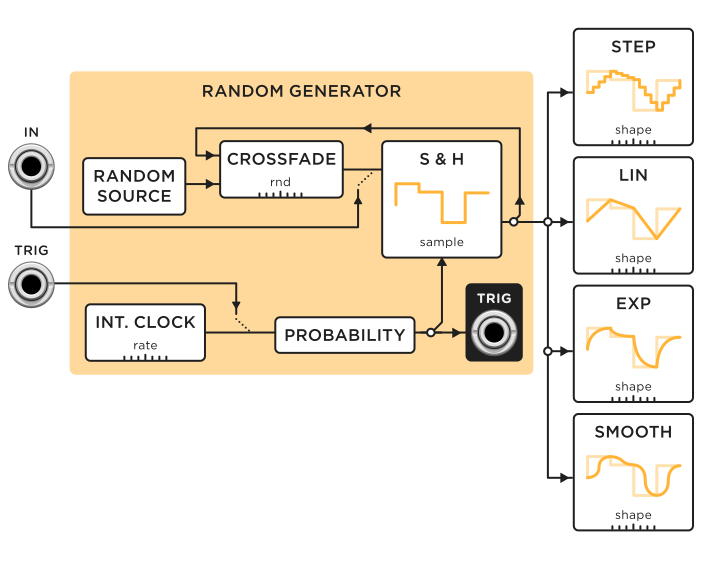
The RATE slider sets the tempo of the internal clock. The CV input below the slider adjusts the clock rate, with 1V/oct calibration when the CV attenuverter is 100%. Upon each clock trigger, the RATE slider light blinks, and there is a chance for the internal random source to generate a new value. This probability is set by the PROB slider, and if a new value was generated, the PROB slider light blinks and a pulse is emitted from the TRIG output.
When the internal random source generates a new value, it mixes the previous value with a random value, with an amount specified by the RND slider. If RND is 100%, the result is fully random and not dependent on the previous value. If RND is 0%, the result always equals the previous value. If RND is between these extremes, the result is random but near the previous value by some margin.
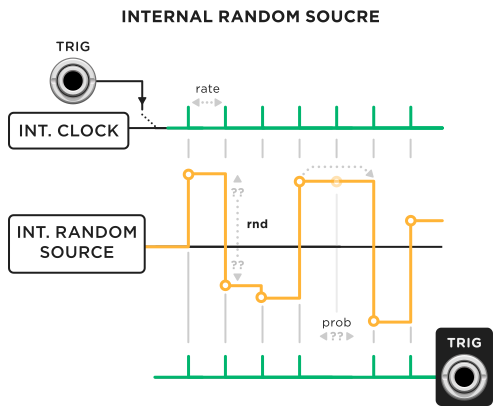
If the TRIG input is patched, the RATE slider is ignored, and the clock is only triggered when an external trigger is received. The PROB slider is used to filter this trigger by some probability.
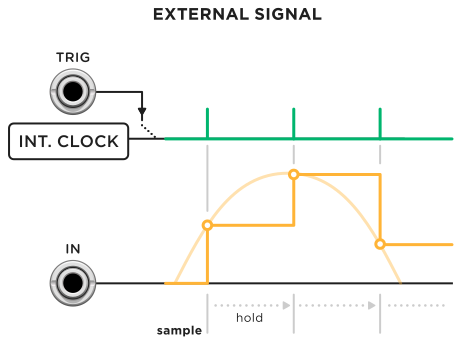
If the IN input is patched, this external voltage is used instead of a random voltage upon each trigger. The RND slider has no effect.
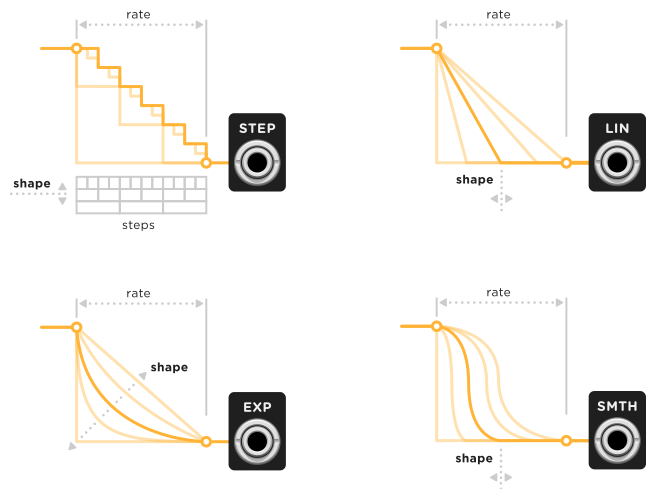
The SHAPE slider sets the shape of all four random outputs. At its lowest position (0%), all outputs immediately jump to the new random value (the target value) when the clock is triggered. At non-zero positions, the outputs interpolate between the previous and the target value, using a different behavior for each output.
-
The STEP output interpolates by a number of equally-spaced steps. At 0% shape, the output jumps directly to the target value in 1 step. At 100% shape, there are 16 steps between the previous and the next clock trigger.
-
The LIN output interpolates linearly with a slope specified by the shape. At 0% shape, the line has infinite slope, jumping directly to the target value. At 100% shape, the output takes the entire clock cycle duration to reach the target value. At intermediate values, the output reaches the target value and holds until the clock cycle finishes.
-
The SMTH output interpolates smoothly between values using sine interpolation. The speed of the interpolation is specified by the shape, and the output holds at the target value until the clock cycle finishes.
-
The EXP output uses exponential interpolation, with its time constant specified by the shape. At 100% shape, the interpolation becomes linear.
The OFST (offset) switch toggles between unipolar (0V to 10V) and bipolar (-5V to 5V) output voltages.