
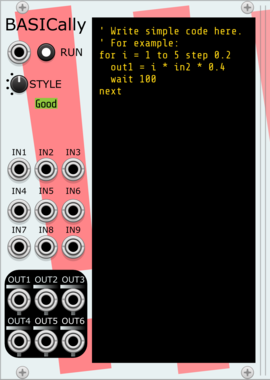
Stochastic Telegraph BASICally
Generate sequences, perform math on inputs, and even multitask with a simple BASIC-like language. Can also send Tipsy text messages to modules that support them (e.g., TTY or Memory).

Stochastic Telegraph Brainwash
Records input and then replaces the contents of a Memory or MemoryCV.
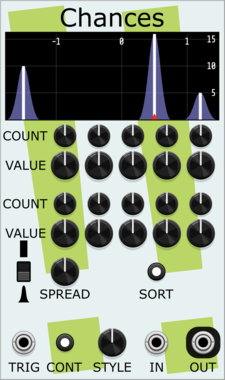
Stochastic Telegraph Chances
Random number generator with discrete probabilities for particular values or ranges of values.
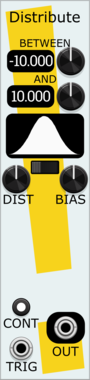
Stochastic Telegraph Distribute
Tunable random voltage generator, with a large variety of random distributions.
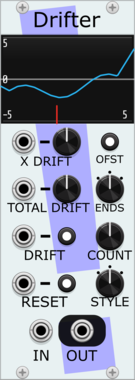
Stochastic Telegraph Drifter
Varying linear function generator. Makes sequences that change in small (or large) ways. A line defined by X/Y points, each doing a random walk.

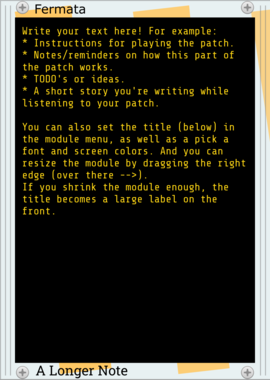
Stochastic Telegraph Fermata
Write much longer text notes, and various sizes of labels. Fermata is resizable, scrolls, has font, font size, and color choices, and more.
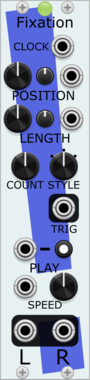
Stochastic Telegraph Fixation
Playback head with a Memory Ensemble that repeatedly plays a short part of the Memory or MemoryCV.
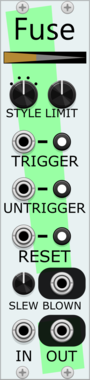
Stochastic Telegraph Fuse
Counts triggers and blocks/allows a signal after hitting a limit. Useful for timed composition changes, simulating components that break with overuse, or scaling a value based on the number of triggers.

Stochastic Telegraph Memory
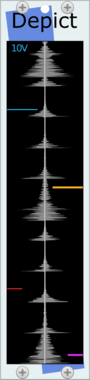
The root part of a Memory Ensemble, optimized for audio. What Fixation and Ruminate reads, Embellish and Brainwash write to and Depict displays.

Stochastic Telegraph MemoryCV
The root part of a MemoryCV Ensemble, optimized for control voltage. What Fixation and Ruminate reads, Embellish and Brainwash write to and Depict displays.

Stochastic Telegraph Ruminate
A playback head within a Memory Ensemble that plays the entire Memory or MemoryCV.
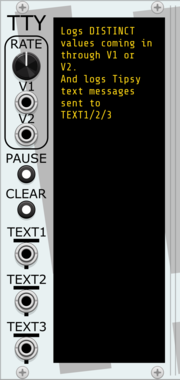
Stochastic Telegraph TTY
Logs values from cables and/or text messages from Tipsy text sources (e.g., BASICally, Memory). Makes monitoring of values or logging far easier. TTY is resizable, scrolls, has font, font size, and color choices, and more.
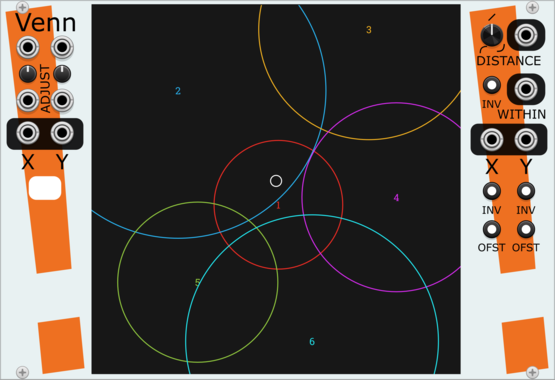
Stochastic Telegraph Venn
2D graphical control signals. A single moving or mouse-driven point causes up to 16 circles to output signals based on the point's position within them.